

I meet patients every single day who tell me the same frustrating story. They brush twice daily, floss religiously, and avoid sugary snacks. Yet somehow, they still end up in my chair getting cavities filled. Then there are those other patients—you probably know someone like this—who barely brush their teeth, drink soda regularly, and never get a single cavity. How is this even possible?
After decades in dentistry, I can tell you that this mystery has puzzled both patients and professionals alike. The answer might surprise you because it involves much more than just brushing and flossing. Today, I want to share what science tells us about why some people seem immune to cavities while others fight tooth decay their entire lives.
The Surprising Truth About Cavity Statistics
Let me start by sharing some numbers that might shock you. According to the Centers for Disease Control and Prevention, about 92% of adults between ages 20 and 64 have had cavities in their permanent teeth at some point in their lives. That means nearly everyone sitting in my waiting room has dealt with tooth decay.
But here is the really interesting part. While most adults have experienced cavities, there is a small group of people who genuinely never develop them. These cavity-resistant individuals exist, and understanding why they stay cavity-free can help everyone improve their dental health.
The statistics show something else important too. By age 9, about 50% of children have already had cavities in either their baby teeth or permanent teeth. Children from lower-income families face even higher risks, with rates more than double those of children from higher-income households. This tells me that cavities are not just about individual habits—there are bigger factors at play.
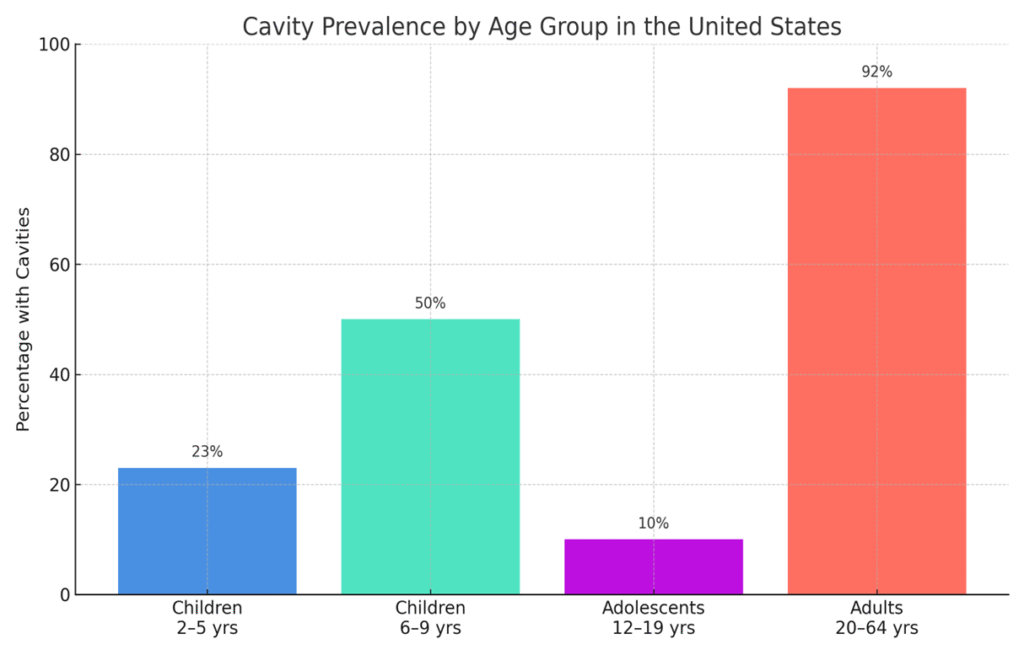
Source: CDC Oral Health Surveillance Report, 2024
Your Genetic Blueprint Matters More Than You Think
One of the most important discoveries in modern dentistry involves genetics. Scientists now know that your genes can account for up to 65% of the differences between people when it comes to cavity risk. Yes, you read that right—65 percent. This means the DNA you inherited from your parents plays a huge role in whether you get cavities easily or stay cavity-free.
Think about it this way. Some people are born with naturally strong tooth enamel. Others inherit weaker enamel that breaks down more easily when exposed to acids. Your genes also control how your body builds teeth during childhood and what minerals get packed into your enamel structure. People with the best mineral combinations essentially have fortress-like teeth that cavity-causing bacteria cannot easily penetrate.
I explain this to my patients using a simple comparison. Imagine two people building houses. One person uses reinforced concrete and steel, while the other uses regular bricks. Both houses might look similar from the outside, but when a storm hits, the reinforced house stands strong while the brick house shows damage. Your tooth enamel works the same way—genetic factors determine how strong your natural defenses are built.
The Secret Power of Saliva
Here is something most people do not realize. Your saliva is like a superhero working 24 hours a day to protect your teeth. But not everyone’s saliva has the same superpowers. The composition of your saliva—determined partly by genetics—can make a massive difference in cavity risk.
Healthy saliva does several amazing things. First, it washes away food particles and bacteria from your teeth. Second, it contains minerals like calcium and phosphate that actually repair tiny weak spots in your enamel before they become cavities. Third, it helps maintain a healthy pH level in your mouth, which prevents acid attacks on your teeth.
People who produce more saliva naturally have better protection against cavities. Their mouths stay cleaner, and the constant flow of saliva gives teeth more opportunities to repair themselves through a process called remineralization. On the flip side, people with dry mouth face much higher cavity risks because they lack this protective barrier.
The pH level of your saliva also matters tremendously. When your mouth’s pH drops below 5.5, your enamel starts to dissolve. Some people naturally have more alkaline saliva, which neutralizes acids quickly and keeps their teeth safe. Others have more acidic saliva, which means their teeth face constant acid attacks throughout the day.
The Bacteria Living in Your Mouth
Your mouth contains hundreds of different types of bacteria. Some are helpful, some are harmless, and some cause cavities. The specific mix of bacteria living in your mouth depends partly on genetics and partly on your environment and habits.
The main villain in the cavity story is a bacterium called Streptococcus mutans. This tiny organism loves sugar and produces acid as a waste product. That acid eats away at tooth enamel and creates cavities. However, here is the fascinating part—some people’s mouths are naturally hostile environments for Streptococcus mutans.
These lucky individuals harbor different bacterial communities that crowd out the harmful cavity-causing bacteria. Their genetic makeup creates an oral environment where the bad bacteria simply cannot thrive. It is like having a natural security system that keeps the troublemakers out before they can cause damage.
I have patients who admit they do not always follow perfect oral hygiene routines, yet they never get cavities. Usually, these patients have beneficial bacterial communities in their mouths that protect them. Meanwhile, other patients who are meticulous about brushing still struggle with decay because their bacterial balance works against them.
Understanding the Demineralization Process
Let me explain what actually happens when a cavity forms. Your tooth enamel is the hardest substance in the human body—even harder than bone. This strong outer layer protects the softer inner parts of your teeth. However, enamel has one weakness. It can dissolve when exposed to acid.
Every time you eat or drink something sugary or acidic, bacteria in your mouth produce acids. These acids pull minerals out of your enamel in a process called demineralization. If this happens too often or too intensely, you get a cavity.
But your body fights back through remineralization. Your saliva deposits minerals back into weakened enamel, essentially repairing the damage. The battle between demineralization and remineralization happens constantly in your mouth. People who never get cavities usually have stronger remineralization processes that repair damage faster than it occurs.
This process explains why timing matters for snacking. When you eat constantly throughout the day, your teeth face repeated acid attacks without enough recovery time. Your saliva never gets a chance to complete the repair work. People who eat meals at regular times and avoid constant snacking give their teeth time to remineralize between acid attacks.
Scientific Fact: The Enamel Formation Window
Here is a scientific fact that surprises many people. The quality of your tooth enamel is determined during childhood when your permanent teeth are forming. Once your teeth are fully formed and erupt into your mouth, you cannot make your enamel thicker or change its basic structure.
The genes that control tooth development are active during these critical years. They orchestrate complex processes that determine how minerals are laid down in your enamel. Some people get lucky with gene variants that create perfectly structured enamel with optimal mineral content. Others receive different genetic instructions that result in enamel that is thinner, weaker, or more porous.
This fact means that nutrition during childhood is extremely important. Children need adequate calcium, phosphate, vitamin D, and other nutrients while their teeth are forming. Parents who ensure their kids get proper nutrition during these years give them the best possible foundation for a lifetime of healthy teeth.
Factors Beyond Your Control and Within Your Control
I want to be clear about something important. While genetics and bacterial communities play huge roles in cavity formation, they are not the whole story. Even people with the best genetic advantages can develop cavities if they neglect their teeth enough. And people with genetic disadvantages can stay cavity-free with excellent care.
Think of genetic factors as setting your baseline risk level. Some people start at low risk and others at high risk, but everyone can move their risk level through their actions and habits. Here are the factors you can control:
Oral Hygiene: Brushing twice daily with fluoride toothpaste and flossing once daily removes plaque before it causes damage. This matters for everyone, regardless of genetics.
Diet: Reducing sugar intake, limiting acidic beverages, and eating nutritious foods all help protect your teeth. Pay special attention to how often you snack, not just what you eat.
Fluoride Exposure: Using fluoride toothpaste and drinking fluoridated water helps strengthen enamel and makes teeth more resistant to acid attacks.
Regular Dental Visits: Professional cleanings remove buildup that brushing cannot reach. Early detection of small problems prevents them from becoming big problems.
Managing Dry Mouth: If you take medications that reduce saliva production, talk with me about strategies to protect your teeth. Staying hydrated, using saliva substitutes, and being extra vigilant about oral hygiene all help.
I tell patients that understanding your personal risk factors helps you make smarter decisions about dental care. Someone with high genetic risk might need more frequent professional cleanings, prescription-strength fluoride, or other preventive treatments. Someone with naturally strong teeth can maintain their advantage by following good basic habits.
Why This Matters for Your Dental Health
Understanding why some people never get cavities gives us powerful tools for prevention. When I know a patient has risk factors like dry mouth, acidic saliva, or a family history of severe decay, I can recommend targeted strategies to overcome those challenges.
Modern dentistry has come so far in our understanding of cavity formation. We now know that one-size-fits-all advice does not work because everyone’s mouth is different. Your bacterial community, saliva composition, enamel structure, and genetic factors create a unique situation that requires personalized care.
This knowledge also helps patients stop blaming themselves unfairly. I have seen people feel guilty about getting cavities despite their best efforts. Understanding that genetics plays such a large role helps them realize that some factors are beyond their control. At the same time, this knowledge empowers everyone to focus on the factors they can control.
The Future of Cavity Prevention
Research continues to reveal new insights about cavity formation and prevention. Scientists are studying ways to change oral bacterial communities to favor helpful bacteria over harmful ones. They are investigating genetic markers that might predict cavity risk early in life. They are developing new materials and treatments that could strengthen enamel or protect teeth in innovative ways.
These advances hold exciting promise for the future. Imagine being able to test your genetic risk factors and bacterial profile, then receive customized treatment recommendations based on your unique situation. This personalized approach to dentistry is becoming more realistic every year.
For now, the best strategy combines time-tested basics with modern understanding. Brush and floss consistently, limit sugar and acid exposure, use fluoride, and visit your dentist regularly. For patients with higher risk factors, we can add extra preventive measures like prescription fluoride products, dental sealants, or more frequent professional cleanings.
Taking Action Today
If you are someone who gets cavities easily despite good habits, do not get discouraged. Understanding your risk factors helps you work with your dentist to develop a more effective prevention strategy. Ask about your saliva production and composition. Discuss your family history. Consider whether medications or health conditions might be affecting your oral environment.
If you are someone who rarely gets cavities, consider yourself fortunate but do not become complacent. Even the strongest genetic advantages need support through good habits. Regular dental checkups ensure that small problems get caught early, and professional guidance helps you maintain your natural advantages.
The mystery of why some people never get cavities has many answers. Genetics sets the stage, saliva composition plays a starring role, bacterial communities fill the supporting cast, and daily habits direct the show. Understanding all these factors gives everyone better tools for maintaining healthy teeth throughout life.
I encourage you to think about your own situation. Do cavities run in your family? Reduced saliva from medications or dry mouth can also play a big role. And habits like frequent snacking or sipping acidic drinks can make teeth even more vulnerable. Answering these questions helps you understand your personal risk profile and what actions will help you most.
Remember that knowledge is power when it comes to dental health. The more you understand about how cavities form and what protects against them, the better equipped you are to keep your smile healthy for life. Whether you are cavity-prone or cavity-resistant, the right combination of professional care and home habits can help you maintain strong, healthy teeth.
If you have questions about your cavity risk or want to discuss personalized prevention strategies, I welcome you to schedule an appointment with me at Smiles by Eddie. Together, we can develop a plan that works with your unique genetic and environmental factors to give you the healthiest smile possible.
For more information on oral health and cavity prevention, I recommend visiting the Centers for Disease Control and Prevention’s oral health resources and the National Institute of Dental and Craniofacial Research, which provide evidence-based information on maintaining excellent dental health.